
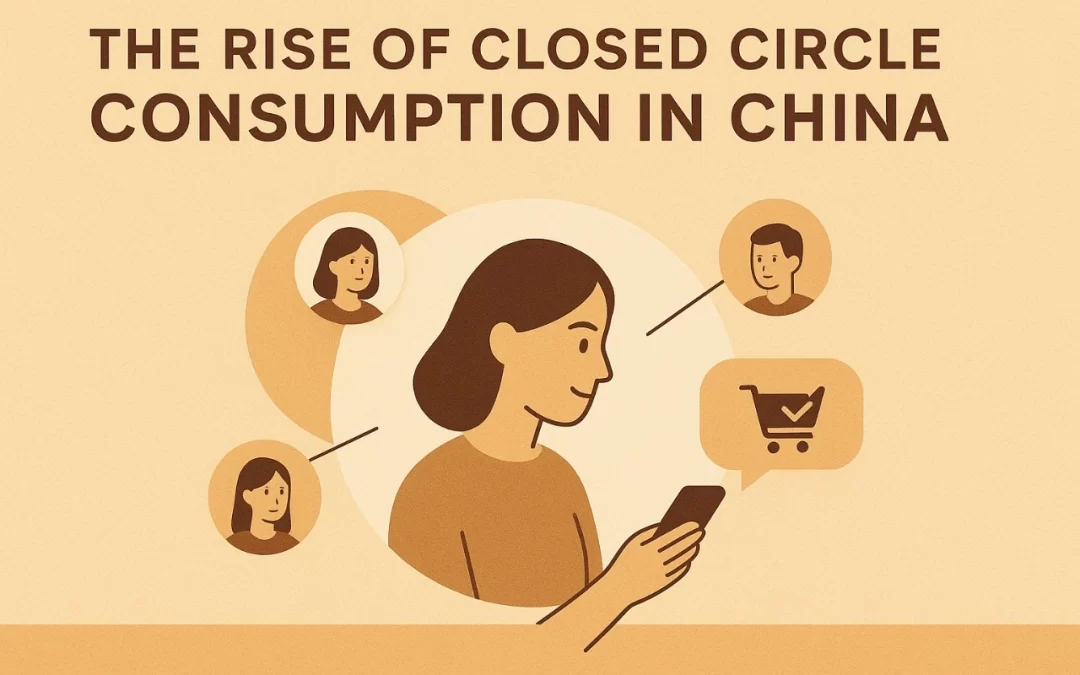
A strong pattern emerging from our recent focus group work is the shift away from open platform browsing toward what respondents described as closed circle filtering. Purchase decisions are increasingly guided by small private groups rather than public recommendations or platform algorithms. The behaviour is less about mistrust of marketing and more about avoiding decision fatigue. People want certainty before they even start searching. Closed Circle Consumption is clearly becoming a dominant behavior among younger urban consumers.
Table of Contents
From discovery to pre-endorsement
What consumers are protecting?
From discovery to pre-endorsement
Instead of opening an app to explore options, many younger urban consumers now begin by asking one or two people they already trust. If nobody in their private circle can name a clear choice, interest fades quickly. It is not fear of new products. It is a reluctance to spend energy. Choosing has become the friction, not paying.
Several participants mentioned private WeChat groups or two-to-three-person Signal chats where product choices are confirmed before purchase. They do not scroll for options. They wait for confirmation. A direct personal recommendation from within that circle is more persuasive than hundreds of positive public ratings. This trend illustrates how Closed Circle Consumption transforms the discovery phase into a tightly filtered process.
Behavioural consequences
This behaviour changes the influence hierarchy. It is no longer KOL versus KOC. It is pre-confirmed versus unconfirmed. Products without a known user within the circle are not actively considered. That does not mean rejected. It means delayed. In contrast, a product with even one strong private endorsement is almost guaranteed a trial.
We also saw participants avoiding being the first to try something new unless it came from a category they were already confident in. The risk they want to avoid is cognitive effort, not financial cost. One respondent said clearly, if nobody in my circle has used it, the timing is not now. Insights from market research further highlight how Closed Circle Consumption is particularly evident here, as it prioritizes energy efficiency over novelty.
Brand strategy implications
Large public campaigns still play a role, but mainly to signal legitimacy and stability. They are not the final persuasion tool. The decisive moment is happening inside small, less visible environments. A brand that succeeds in these channels often does so through lightweight, low-pressure entry points that allow private testing without requiring immediate purchase or public interaction.
This may involve distributing limited trial units to private group hosts or allowing a one-click summary share that can be sent quietly inside a chat. The brand is not seeking maximum exposure but precise relevance in micro networks. Through focused market research, companies can better understand these evolving consumer dynamics. Understanding Closed Circle Consumption allows marketers to engage meaningfully in these small networks without overspending on broad campaigns.
What consumers are protecting?
The most common explanation given for this behaviour was not risk avoidance but energy protection. Everything feels like work, one participant said. If I do not have to research, I will not. The circle is not purely social. It is a decision filter. Trust here is not emotional. It is functional. It saves time. The rise of Closed Circle Consumption reflects a broader cultural trend in China toward efficiency and mental bandwidth conservation.
Final Thoughts
This is not resistance to technology or a preference for a niche. It is a response to excessive choice and the mental burden of evaluation. The point is not less information but fewer decisions. In that environment, presence in the right small conversation may carry more commercial value than visibility on the front page of a platform. Brands that grasp Closed Circle Consumption early will find an advantage in targeting precise micro networks. To learn how your brand can adapt, contact us today.
FAQs
- What is this new consumer trend about?
It refers to buying behaviors influenced by small, trusted private groups instead of relying on public reviews or algorithmic recommendations. - Why is this trend growing rapidly in China?
It’s increasing due to decision fatigue and a desire to save mental energy, making private endorsements far more persuasive than public ones. - How does this new behavior impact brands?
Brands now need to focus on engaging smaller, close-knit networks and offering low-pressure trial experiences instead of relying only on mass campaigns. - Which platforms are shaping this private buying behavior?
Messaging tools such as WeChat and Signal are key, as they enable intimate, trust-based conversations that guide purchasing choices. - Do consumers now avoid trying new products?
Not entirely, they simply wait for confirmation from trusted peers before buying, preferring confidence and ease over exploration.